Monday 2 August 2027 · Sohag
The 2 August 2027 eclipse in Akhmim
Total eclipse
On Monday 2 August 2027 the eclipse will be total in Akhmim: the Moon will cover the Sun completely for 6 min 23 s, with the maximum at 13:02, Egypt time (UTC+3, summer time). Totality runs from 12:58:53 to 13:05:16. The partial phase begins at 11:37 and ends at 14:23. For 2 h 46 min the Sun burns: you need eclipse glasses, and they only come off once the Sun has disappeared completely, going back on as soon as the first point of light returns.
Eclipse times in Akhmim
- Starts (partial) 11:37
- Maximum 13:02
- Ends 14:23
- Sun’s altitude 81.2°
Only here
- By seconds of totality, Akhmim ranks no. 169 of the 291 places in the Sohag Governorate inside the path, and no. 272 of the 1,208 in Egypt. Tied with 49 others.
All times in Egypt time (UTC+3, summer time). Calculated at the coordinates of the place (26.5622, 31.7457), from GeoNames.
Eclipse merch
Shipping to Egypt: €19.99. Prices: no VAT (export).
It's made in another country and enters your country as an import. On delivery, the carrier will charge you the import taxes (VAT and duties, if any) and a handling fee. They're not included in the price.
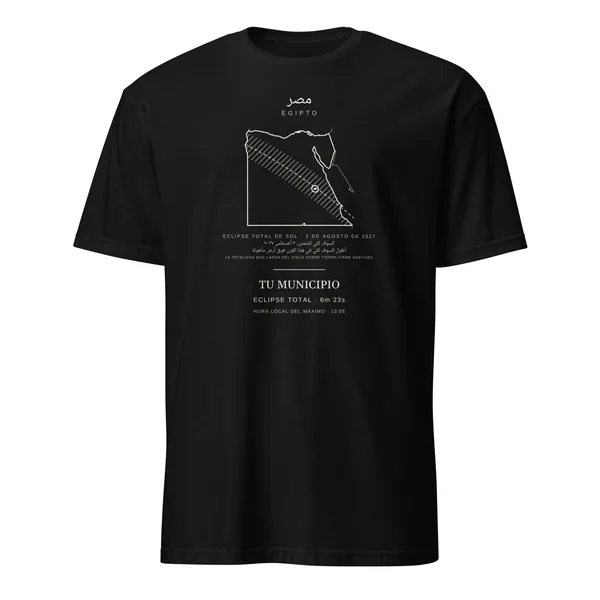 Eclipse T-shirt€23.95Arrives in 9-15 days
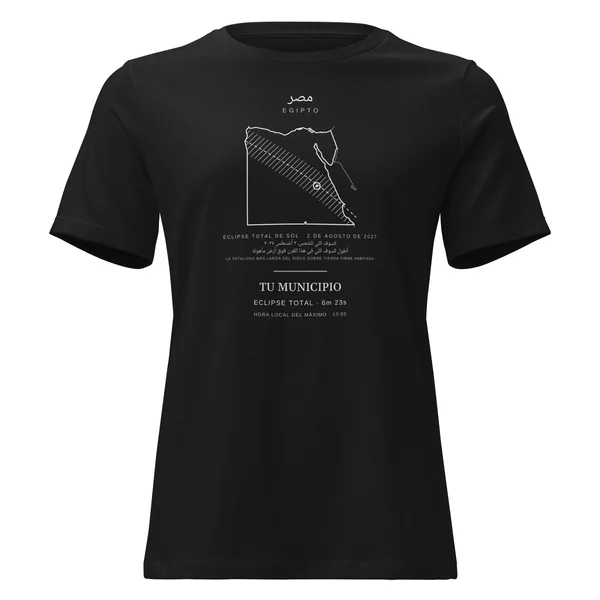 Eclipse T-shirt · women’s cut€33.95Arrives in 10-17 days
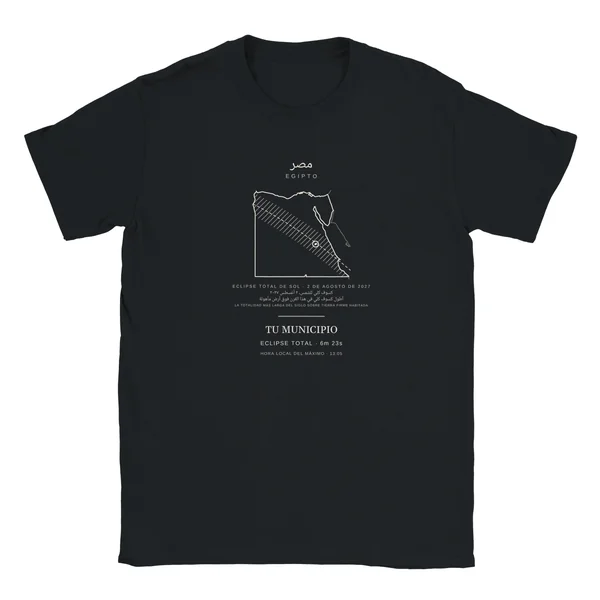 Eclipse T-shirt · kids€27.95Arrives in 13-22 days
 Eclipse sweatshirt€54.95Arrives in 9-15 days
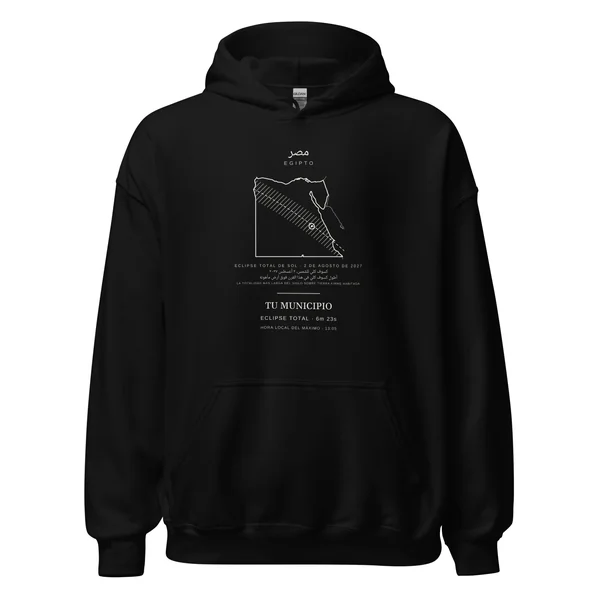 Eclipse hoodie€61.95Arrives in 9-15 days
 Eclipse sweatshirt · front and back€62.95Arrives in 9-15 days
 Eclipse hoodie · front and back€69.95Arrives in 9-15 days
 Eclipse T-shirt · front and back€31.95Arrives in 9-15 days
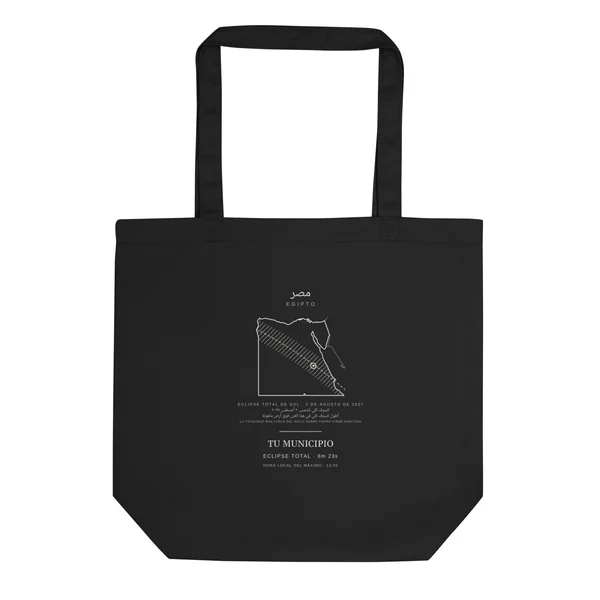 Eclipse tote bag€40.95Arrives in 9-15 days
 Eclipse poster€32.95Arrives in 12-21 days
 Eclipse canvas print€68.95Arrives in 13-22 days
 Eclipse mug€26.95Arrives in 14-24 days
Tell the people you’ll be watching it with
Send it to your group Akhmim: 6 min 23 s of totality at 13:02One tap — the message is already written, you just pick who gets it.
With the naked eye
What you will actually notice in Akhmim
- 11:37 The Moon touches the edge of the Sun and the light starts to drop. You will not see it yet: a small bite out of a Sun that is still dazzling.
- 81 min of steady fading until maximum. In the last stretch it becomes obvious: shadows sharpen, colours go flat and the air goes still in Akhmim.
- 13:02 Maximum. Night falls at 12:58:53 and lifts at 13:05:16.
- 383 s of night in broad daylight. The corona appears, the sky darkens and the temperature drops. This is the ONLY stretch where the glasses come off, and only once the Sun has completely disappeared: put them straight back on at the first point of light.
- 81.2° above the horizon at maximum. With the Sun this high you do not need a clear horizon: just make sure no nearby building is in the way.
- 14:23 The disc is whole again and the eclipse is over.
On 1 August we'll email you your time in Akhmim
Today you're looking up the time; the day that counts is 2 August. The day before, we'll send you one email with the eclipse time in Akhmim (maximum at 13:02) and the cloud forecast for your area. One email, and you can unsubscribe in one click.
To the second
The phases of the eclipse in Akhmim
| Eclipse begins | 11:37:26 |
|---|---|
| Totality begins | 12:58:53 |
| Maximum | 13:02:05 |
| Totality ends | 13:05:16 |
| Eclipse ends | 14:23:30 |
| Share of the Sun covered | 100.0% |
| Magnitude | 1.036 |
| Sun’s altitude at maximum | 81.2° |
The experience
What you will see in Akhmim
At 11:37, the Moon will touch the edge of the solar disc and the partial phase will begin in Akhmim. Over the next 81 minutes the bite will grow —always watched through eclipse glasses— and in the last minutes the midday light will drop noticeably, with sharper shadows and a strangely muted atmosphere.
At 12:58 come Baily’s beads and the diamond ring: the last ray of Sun shining over the Moon’s edge. Right after, totality: for 6 min 23 s, the solar corona will appear around the Moon’s black disc, the sky will darken like a deep twilight and the temperature will fall. Only then, with the Sun completely gone, do the glasses come off.
At 13:05, a second diamond ring will mark the end of totality: as soon as the first point of light appears, the glasses go back on. The waning partial phase will end at 14:23.
During totality, the Sun will be high: 81.2° above the horizon. There is no need to look for a clear horizon; it is enough that no nearby building blocks it. With the Sun almost overhead, looking up for so long is tiring: a mat or a reclining chair helps.
Share the data for Akhmim
Only look at the Sun with protection: eclipse glasses with a filter that meets ISO 12312-2; sunglasses are no use. They only come off once the Sun has disappeared completely, and go back on as soon as the first point of light appears: what you see decides, not the clock. How to choose them, in our glasses guide.
Common questions
Frequently asked questions about the eclipse in Akhmim
What time is the eclipse in Akhmim?
It begins at 11:37, peaks at 13:02 and ends at 14:23, Egypt time (UTC+3, summer time), on Monday 2 August 2027.
Will the eclipse of 2 August 2027 be total in Akhmim?
Yes. Akhmim is inside the path of totality: the Sun will be fully covered for 6 min 23 s, from 12:58:53 to 13:05:16.
How long does the eclipse last in Akhmim?
The whole event, from the first to the last partial phase, lasts 2 h 46 min: from 11:37 to 14:23. Totality, 6 min 23 s.
How high will the Sun be in Akhmim?
At maximum, 81.2° above the horizon. It is high: it is enough that no nearby building blocks it.
What glasses do I need to watch the eclipse?
Eclipse glasses with a filter that meets ISO 12312-2, or a solar filter for a telescope or binoculars; sunglasses are no use, not even stacked. They only come off during totality, with the Sun fully covered.
Where will the eclipse be total in Egypt?
In Egypt, the path of totality crosses 1,208 places. The longest is Girga, with 6 min 25 s.
What is the weather like in August in Akhmim?
The nearest reference is Asyut: in August, an average high of 37.6 °C and a low of 23.2 °C. Sources and the rest of the country, on our weather page.
How do I get to Akhmim?
The nearest base in our travel guide is Sohag, 5 km away in a straight line. The Egypt guide explains how to get there and how to move around on eclipse day.
Keep planning
Place by place
The eclipse in neighbouring places
The places closest to Akhmim, each with its own timetable (straight-line distance, our own calculation):
- Eclipse in Bindar al Kirmaniyah — total, 6 min 23 s, 2 km away
- Eclipse in Kawther — total, 6 min 24 s, 2 km away
- Eclipse in Awlad Shulul — total, 6 min 23 s, 4 km away
- Eclipse in Al Hawawish — total, 6 min 22 s, 4 km away
- Eclipse in Balasfurah — total, 6 min 24 s, 4 km away
- Eclipse in Al Bayyadiyah Bin Nazir — total, 6 min 23 s, 5 km away
- Eclipse in Sohag — total, 6 min 24 s, 5 km away
- Eclipse in Al ‘Isawiyah Sharq — total, 6 min 22 s, 6 km away
Places: UN administrative boundaries (OCHA COD-AB for Egypt, produced by CAPMAS, CC BY-IGO) and GeoNames (geonames.org, CC BY 4.0). Times and durations: our own calculation with JPL’s DE440s ephemeris, in Egypt time (UTC+3, summer time on 2 August 2027).