Monday 2 August 2027 · Riyadh
The 2 August 2027 eclipse in Al-Kharj
Partial eclipse
On Monday 2 August 2027 the eclipse will be partial in Al-Kharj: the Moon will cover 75.8% of the solar disc, with the maximum at 13:34, Saudi Arabia time (UTC+3). It begins at 12:15 and ends at 14:46. In Saudi Arabia, totality will be seen in 1,313 places; the longest, in Al Ghubbah (6 min 14 s). Not being total does not take away a minute of danger: 75.8% leaves Sun in view all the time, so for 2 h 31 min you need eclipse glasses and here they never come off.
Eclipse times in Al-Kharj
- Starts (partial) 12:15
- Maximum 13:34
- Ends 14:46
- Sun’s altitude 66.4°
Only here
- Al-Kharj stays at 75.8%: of the 116 places in Saudi Arabia that miss totality, it is no. 66 closest to 100% (no. 20 of 27 in the Riyadh Province). Tied with 3 others.
All times in Saudi Arabia time (UTC+3). Calculated at the place’s coordinates (24.1554, 47.3346), from GeoNames.
Before you travel, read the official travel advice: FCDO (UK government), checked on 30 October 2026.
Eclipse merch
Shipping to Saudi Arabia: €19.99. Prices: no VAT (export).
It's made in another country and enters your country as an import. On delivery, the carrier will charge you the import taxes (VAT and duties, if any) and a handling fee. They're not included in the price.
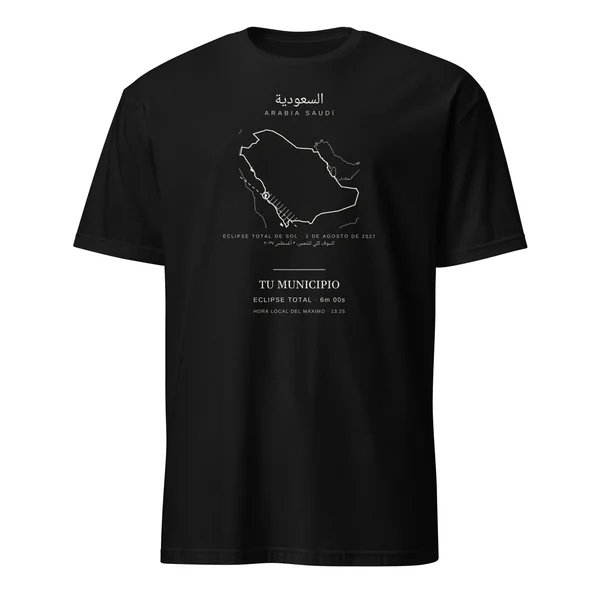 Eclipse T-shirt€23.95Arrives in 7-10 days
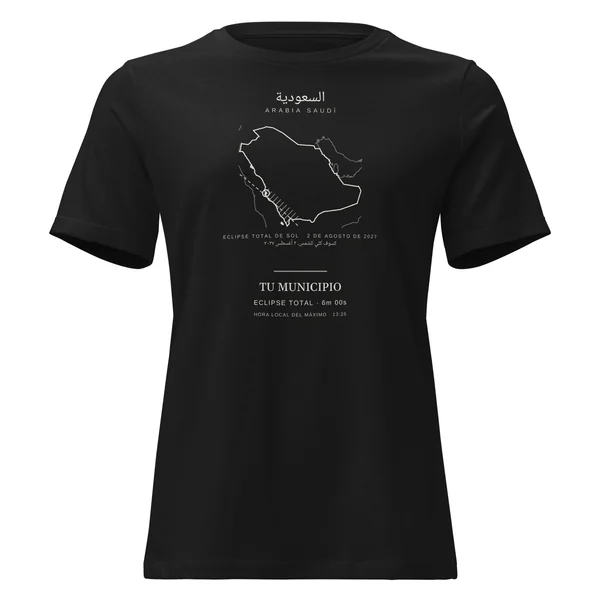 Eclipse T-shirt · women’s cut€33.95Arrives in 7-10 days
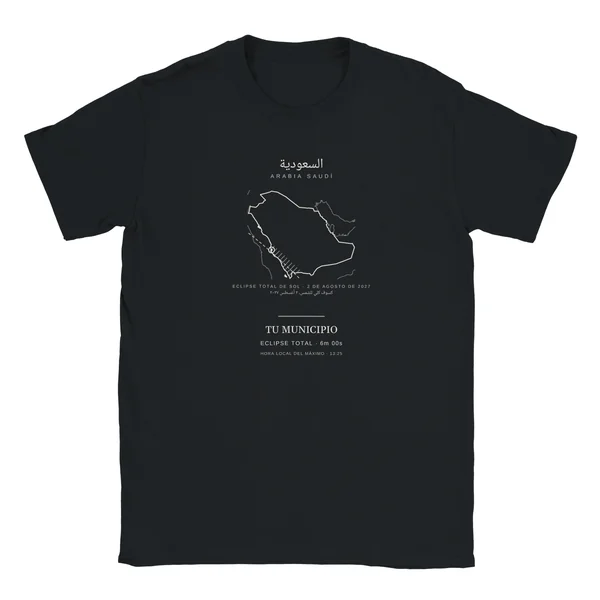 Eclipse T-shirt · kids€27.95Arrives in 13-20 days
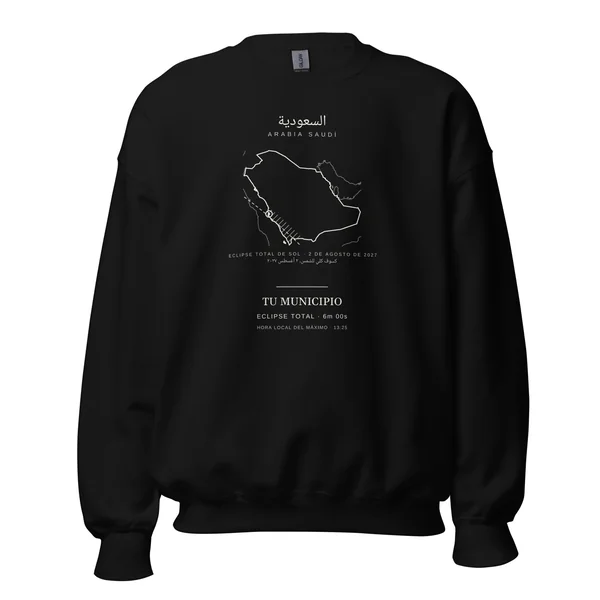 Eclipse sweatshirt€54.95Arrives in 7-10 days
 Eclipse hoodie€61.95Arrives in 7-10 days
 Eclipse sweatshirt · front and back€62.95Arrives in 7-10 days
 Eclipse hoodie · front and back€69.95Arrives in 7-10 days
 Eclipse T-shirt · front and back€31.95Arrives in 7-10 days
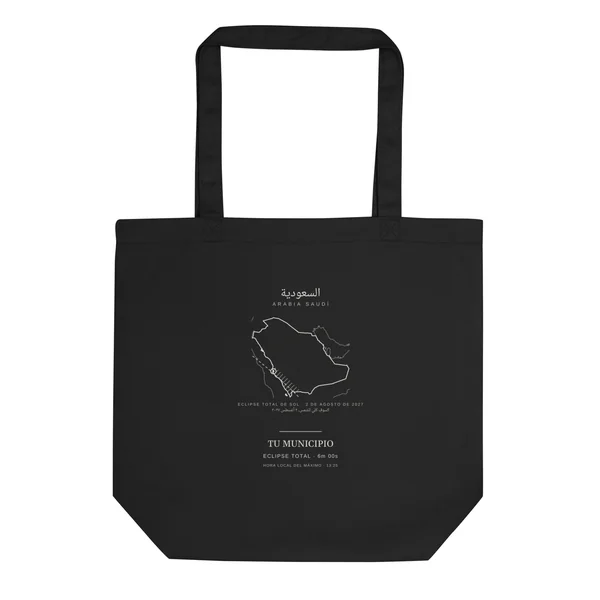 Eclipse tote bag€40.95Arrives in 7-10 days
 Eclipse poster€32.95Arrives in 7-10 days
 Eclipse mug€26.95Arrives in 10-13 days
Tell the people you’ll be watching it with
Send it to your group Al-Kharj: 75.8% of the Sun covered at 13:34One tap — the message is already written, you just pick who gets it.
With the naked eye
What you will actually notice in Al-Kharj
- 12:15 The Moon touches the edge of the Sun and the light starts to drop. You will not see it yet: a small bite out of a Sun that is still dazzling.
- 79 min of steady fading until maximum. In the last stretch it becomes obvious: shadows sharpen, colours go flat and the air goes still in Al-Kharj.
- 13:34 Maximum: the Moon covers 75.8% of the Sun.
- 75.8 % of the Sun covered. The light will turn strange — flat and cold, like a storm that never arrives — but it does NOT go dark: for that you have to be inside the path of totality.
- 66.4° above the horizon at maximum. With the Sun this high you do not need a clear horizon: just make sure no nearby building is in the way.
- 14:46 The disc is whole again and the eclipse is over.
Real night, 690 km away: the eclipse in Al Hazimi (Asir Province) →
On 1 August we'll email you your time in Al-Kharj
Today you're looking up the time; the day that counts is 2 August. The day before, we'll send you one email with the eclipse time in Al-Kharj (maximum at 13:34) and the cloud forecast for your area. One email, and you can unsubscribe in one click.
To the second
The phases of the eclipse in Al-Kharj
| Eclipse begins | 12:15:48 |
|---|---|
| Maximum | 13:34:28 |
| Eclipse ends | 14:46:27 |
| Share of the Sun covered | 75.8% |
| Magnitude | 0.796 |
| Sun’s altitude at maximum | 66.4° |
The experience
What you will see in Al-Kharj
At 12:15, the Moon will start crossing in front of the Sun in Al-Kharj. At maximum, at 13:34, it will cover 75.8% of the disc: through eclipse glasses you will see the Moon’s bite in the Sun, although the drop in light will be subtle to the naked eye.
The full experience —the corona, the sudden darkness, the planets in view— only exists inside the path of totality, which in Saudi Arabia crosses 1,313 places. The nearest to Al-Kharj is about 690 km away: in Al Hazimi (Asir Province) it will last 26 s. If you can travel that day, few things are more worth it; if not, 75.8% is still a show worth getting the glasses ready for.
At maximum, the Sun will be high: 66.4° above the horizon. There is no need to look for a clear horizon; it is enough that no nearby building blocks it. With the Sun almost overhead, looking up for so long is tiring: a mat or a reclining chair helps.
Share the data for Al-Kharj
The way to the path
The nearest totality
Where the eclipse will be total near Al-Kharj (straight-line distance, our own calculation):
Only look at the Sun with protection: eclipse glasses with a filter that meets ISO 12312-2; sunglasses are no use. In Al-Kharj the eclipse is not total, so they never come off. How to choose them, in our glasses guide.
Common questions
Frequently asked questions about the eclipse in Al-Kharj
What time is the eclipse in Al-Kharj?
It begins at 12:15, peaks at 13:34 and ends at 14:46, Saudi Arabia time (UTC+3), on Monday 2 August 2027.
Will the eclipse of 2 August 2027 be total in Al-Kharj?
No. It is partial: the Moon will cover 75.8% of the Sun at 13:34. The nearest totality is in Al Hazimi (26 s), about 690 km away.
How long does the eclipse last in Al-Kharj?
The whole event, from the first to the last partial phase, lasts 2 h 31 min: from 12:15 to 14:46.
How high will the Sun be in Al-Kharj?
At maximum, 66.4° above the horizon. It is high: it is enough that no nearby building blocks it.
What glasses do I need to watch the eclipse?
Eclipse glasses with a filter that meets ISO 12312-2, or a solar filter for a telescope or binoculars; sunglasses are no use, not even stacked. In Al-Kharj they never come off: the Sun is never fully covered.
Where will the eclipse be total in Saudi Arabia?
In Saudi Arabia, the path of totality crosses 1,313 places. The longest is Al Ghubbah, with 6 min 14 s.
How do I get to Al-Kharj?
The nearest base in our travel guide is Al Bahah, 760 km away in a straight line. The Saudi Arabia guide explains how to get there and how to move around on eclipse day.
Keep planning
Place by place
The eclipse in neighbouring places
The places closest to Al-Kharj, each with its own timetable (straight-line distance, our own calculation):
- Eclipse in Al Hayathim — partial, 76.0%, 10 km away
- Eclipse in Ad-Dilam — partial, 76.7%, 25 km away
- Eclipse in Riyadh — partial, 75.8%, 86 km away
- Eclipse in Hawtah Bani Tamim — partial, 79.0%, 87 km away
- Eclipse in Al Hulwah — partial, 79.4%, 97 km away
- Eclipse in Diriyah — partial, 76.0%, 104 km away
- Eclipse in Al Jubaylah — partial, 75.8%, 123 km away
- Eclipse in Al Uyaynah — partial, 76.0%, 127 km away
Places: the provinces from the UN administrative boundaries (OCHA COD-AB for Saudi Arabia, from GADM, CC BY-IGO), towns and villages from GeoNames (geonames.org, CC BY 4.0) and names from Wikidata (CC0) and Wikipedia. Times and durations: our own calculation with JPL’s DE440s ephemeris, in Saudi Arabia time (UTC+3, all year round, with no daylight saving time).