Wednesday, 12 August 2026 · Guadalajara, Spain
Solar eclipse in Pozo de Guadalajara
Total eclipse
On Wednesday 12 August 2026 the eclipse will be total in Pozo de Guadalajara: the Moon will cover the Sun completely for 0m 55s, with maximum at 20:32 (Peninsular Spain time). The partial phase starts at 19:36 and the Sun sets at 21:14, still eclipsed. It is the first total eclipse visible from mainland Spain since 1905 (source: IGN).
Eclipse times in Pozo de Guadalajara
- Starts (partial) 19:36
- Maximum 20:32
- Sun sets 21:14
- Sun’s altitude 6.9°
All times in local time in mainland Spain and the Balearics (CEST, UTC+2) — no conversion needed on site. Our own calculation for this municipality’s coordinates, cross-checked against Spain’s IGN.
The eclipse shop
Glasses to watch it, and a keepsake with the name of your town
-
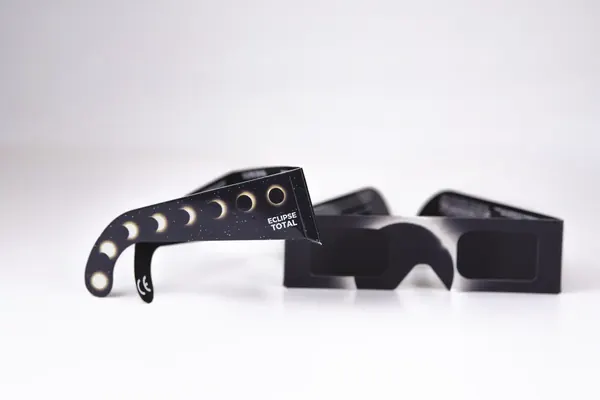 Certified to EN ISO 12312-2 Certified eclipse glasses desde €4.50 Delivery 24-72 h Buy in our shop
 -
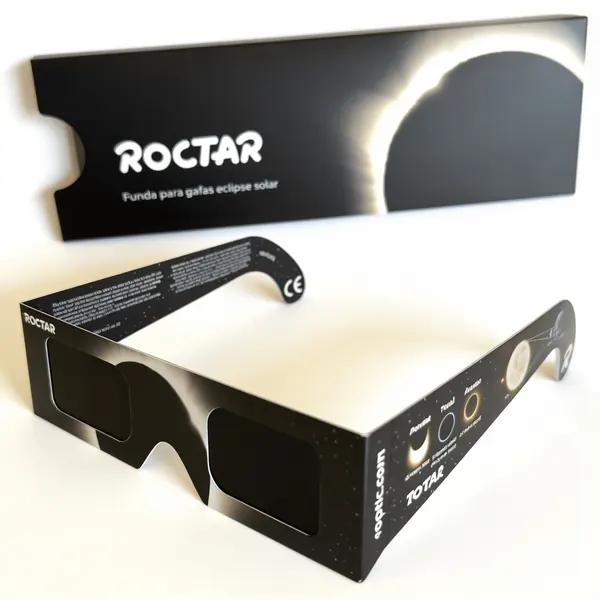 Certified to EN ISO 12312-2 Certified eclipse glasses with case desde €5.50 Delivery 24-72 h Buy in our shop
 -
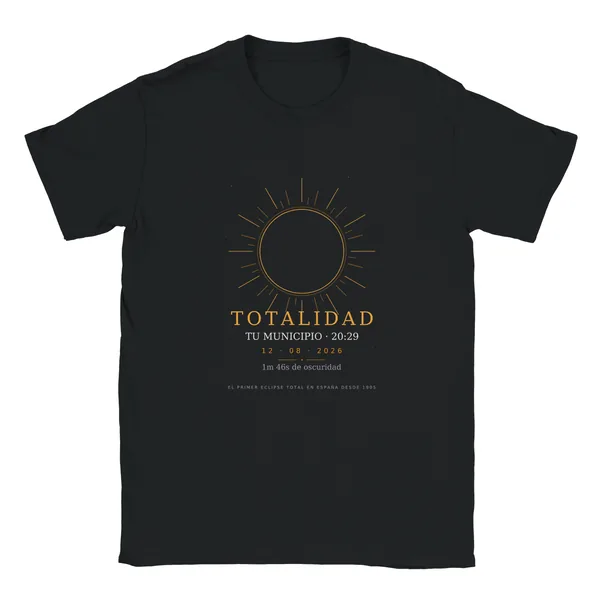 Printed with POZO DE GUADALAJARA Eclipse T-shirt desde €23.95 Arrives in 3-4 working days Buy in our shop
 -
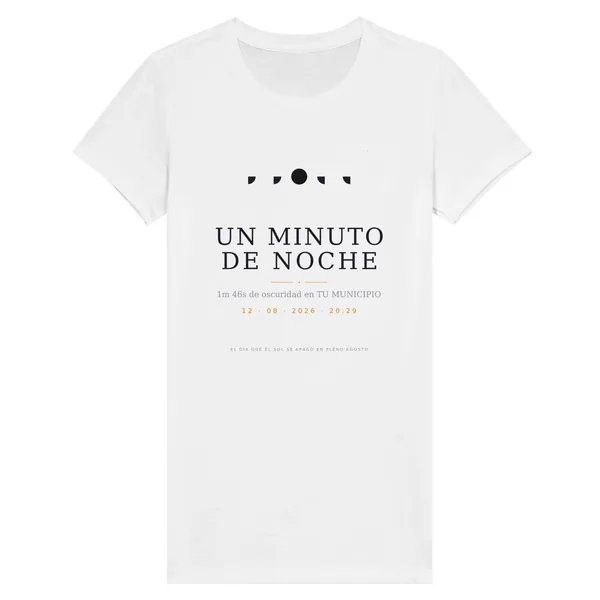 Printed with POZO DE GUADALAJARA Eclipse T-shirt · women’s cut desde €33.95 Arrives in 3-4 working days Buy in our shop
 -
 Printed with POZO DE GUADALAJARA Eclipse tank top €33.95 Arrives in 8-12 days depending on the size Buy in our shop
 -
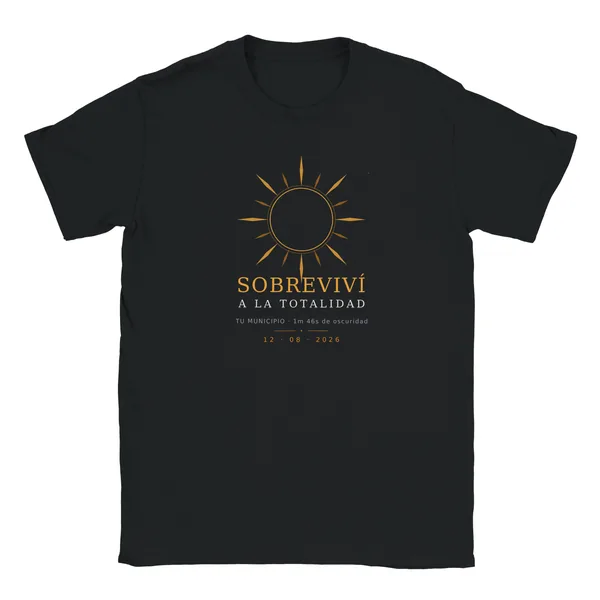 Printed with POZO DE GUADALAJARA Eclipse T-shirt · kids €27.95 Arrives in 8-14 days Buy in our shop
 -
 Printed with POZO DE GUADALAJARA Eclipse sweatshirt desde €54.95 Arrives in 3-4 working days Buy in our shop
 -
 Printed with POZO DE GUADALAJARA Eclipse hoodie desde €61.95 Arrives in 3-4 working days Buy in our shop
 -
 Printed with POZO DE GUADALAJARA Eclipse sweatshirt · front and back desde €62.95 Arrives in 3-4 working days Buy in our shop
 -
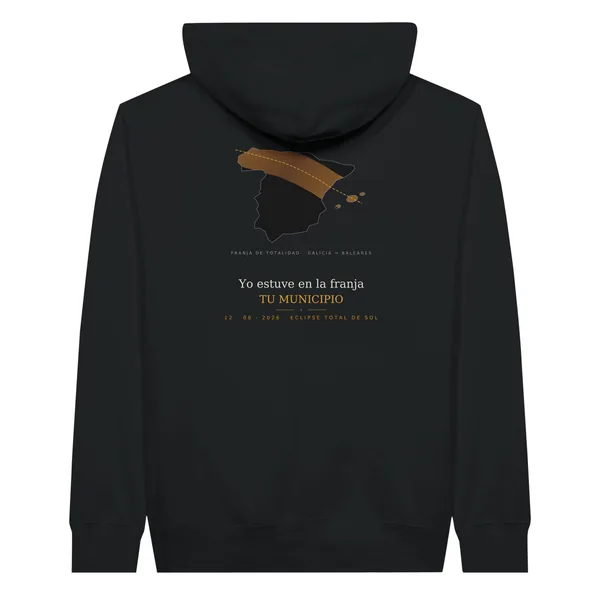 Printed with POZO DE GUADALAJARA Eclipse hoodie · front and back desde €69.95 Arrives in 3-4 working days Buy in our shop
 -
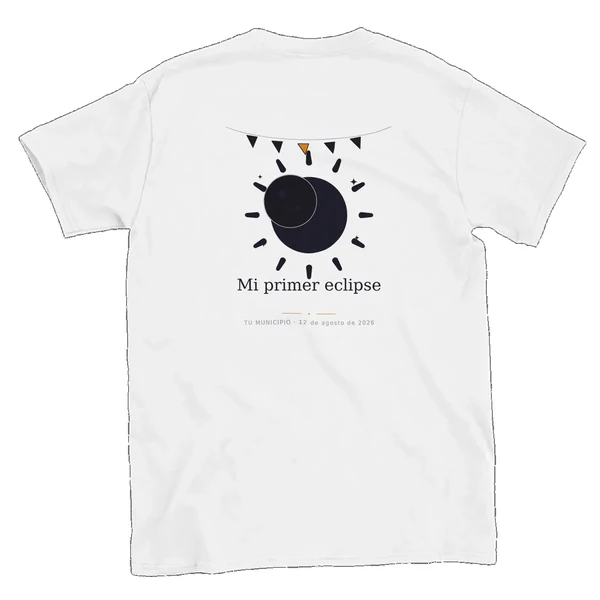 Printed with POZO DE GUADALAJARA Eclipse T-shirt · front and back desde €31.95 Arrives in 3-4 working days Buy in our shop
 -
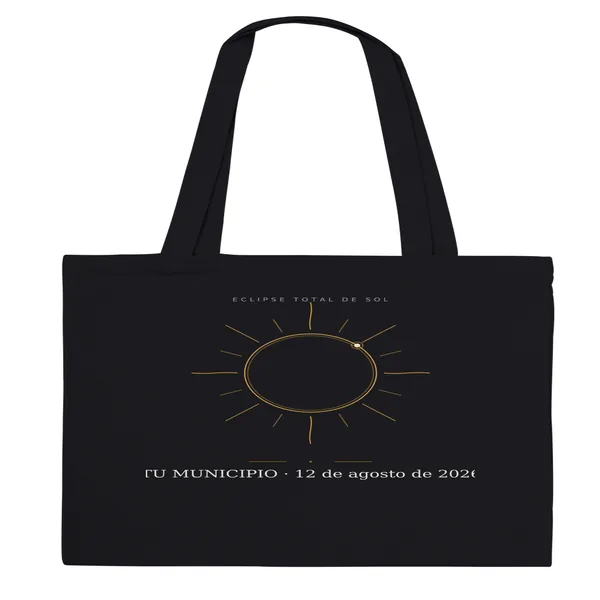 Printed with POZO DE GUADALAJARA Eclipse tote bag €40.95 Arrives in 3-4 working days Buy in our shop
 -
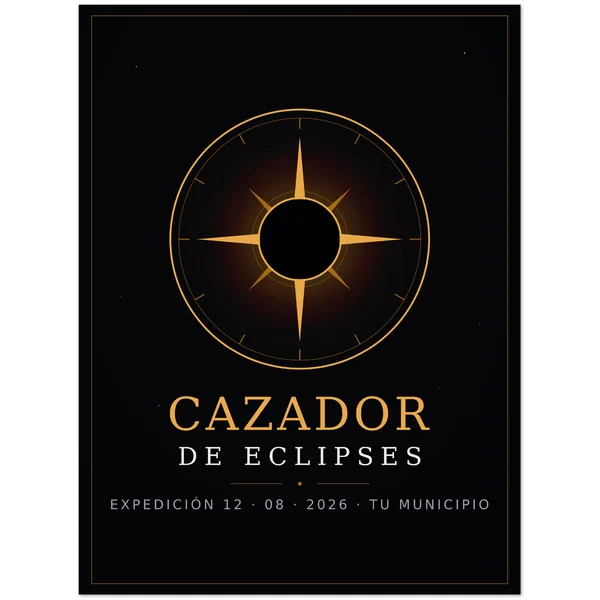 Printed with POZO DE GUADALAJARA Eclipse poster €32.95 Arrives in 3-7 days Buy in our shop
 -
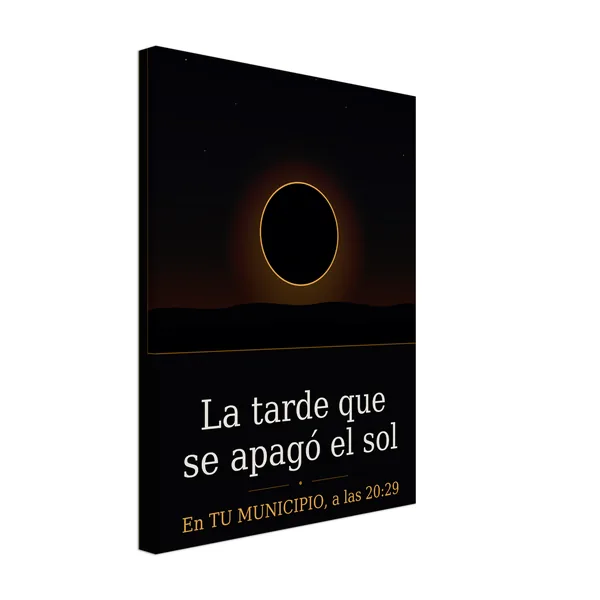 Printed with POZO DE GUADALAJARA Eclipse canvas print €68.95 Arrives in 4-7 days Buy in our shop
 -
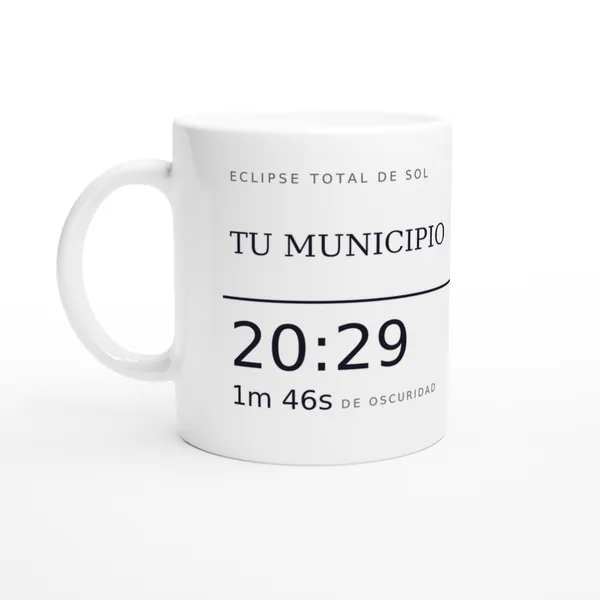 Printed with POZO DE GUADALAJARA Eclipse mug €26.95 Arrives in 3-6 days Buy in our shop
 -
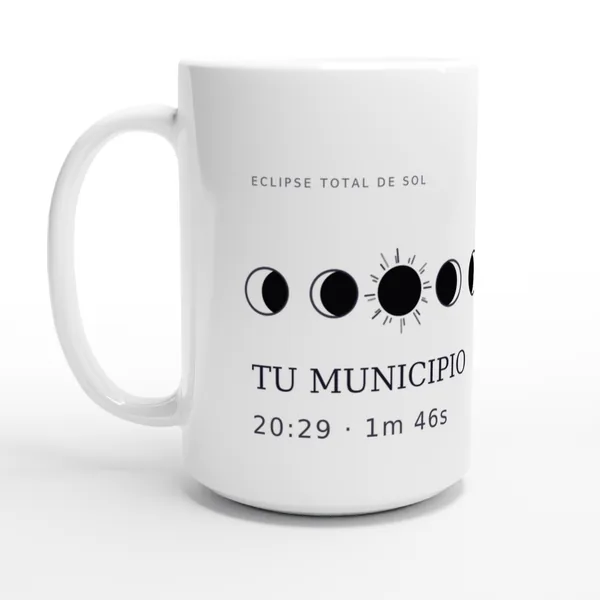 Printed with POZO DE GUADALAJARA Large eclipse mug €30.95 Arrives in 3-6 days Buy in our shop
 -
 Printed with POZO DE GUADALAJARA Eclipse camp mug €35.95 Arrives in 3-6 days Buy in our shop
Everything we make is printed with Pozo de Guadalajara’s own data: its name, 20:32 and its seconds of totality. Pick an item and it opens with Pozo de Guadalajara already filled in — you see it before you pay.
See all 15 customisable items Made once you order it — that is why there is a lead time. Prices and lead times come from the catalogue, measured with real orders on 27 July 2026. Third-party gear links to our own page, with the standard and the date it was checked.
Tell the people you’ll be watching it with
Send it to your group Pozo de Guadalajara: 0m 55s of totality at 20:32One tap — the message is already written, you just pick who gets it.
The terrain
The horizon at Pozo de Guadalajara in the Sun's direction
- In the direction the Sun will be in at maximum, the ground rises 0.2° above the horizontal at Pozo de Guadalajara: a rise of 895 m, 1.7 km away, with the reference point of the municipality 886 m above sea level.
- At that same moment the Sun will be 7.0° above the horizon at Pozo de Guadalajara. That is the APPARENT altitude: it already includes atmospheric refraction, which close to the horizon lifts the disc by a couple of tenths of a degree, which is why it does not match the geometric altitude in the card above to the decimal.
- The subtraction leaves 6.8° of margin. The Sun's disc is half a degree across, so the Sun will sit about 15 solar discs above the terrain profile: in that direction the relief is not what decides. What can block it at that height is what this calculation does not see.
That obstacle is close, and at that range a 28-metre cell swallows the crest: 14 municipalities with the obstacle that close were checked against the IGN, and in 13 of them this calculation came out below the real terrain, by between half a degree and four. The sum above is optimistic here, so leave yourself room.
This calculation looks ONLY at bare ground: it does not see buildings, sheds or trees. In a village or a city, the building across the street blocks more than the ridge in the distance. It sweeps 60 km all around with cells of about 28 metres and starts looking 300 metres out from the point, which is the distance at which you are no longer looking at your own roof. And the point is the reference point of the municipality: 500 metres away the number shifts by several degrees.
Elevation model served by AWS Terrain Tiles (terrarium format) at zoom 12: about 28 metres per cell at the latitude of Spain. Checked against the IGN's MDT25 (PNOA-LiDAR), the official Spanish model, in 21 municipalities spread along the path (coast, islands, plateau, closed valley and city): the median difference is 0.0° and 20 of the 21 fall within half a degree. Produced using Copernicus data and information funded by the European Union — EU-DEM layers.
With the naked eye
What you will actually notice in Pozo de Guadalajara
- 19:36The Moon touches the edge of the Sun and the light starts to drop. You will not see it yet: a small bite out of a Sun that is still dazzling.
- 55 minof steady fading until maximum. In the last stretch it becomes obvious: shadows sharpen, colours go flat and the air goes still in Pozo de Guadalajara.
- 20:32Maximum. Night falls at 20:32 and lifts at 20:33.
- 55 sof night in broad daylight, exactly. The corona appears, Venus and Jupiter come out and the temperature drops. This is the ONLY stretch where the glasses come off — put them straight back on when the first ray returns.
- 6.9°The Sun will be very low at maximum. Pick a spot with a clear western horizon in advance: a row of houses or a nearby hill is enough to miss it.
- 21:14The Sun sets while still eclipsed: here the eclipse does not end, it disappears. The last thing you see is a bitten Sun sinking below the horizon.
Timeline of the evening in Pozo de Guadalajara
- Partial phase begins: 19:36
- Maximum: 20:32
- Sunset (still eclipsed): 21:14
- Totality: 20:32–20:33 (0m 55s)
On 11 August we'll email you your time in Pozo de Guadalajara
Today you're looking up the time; the day that counts is 12 August. The day before, we'll send you one email with the eclipse time in Pozo de Guadalajara (maximum at 20:32) and the cloud forecast for your area. One email, and you can unsubscribe in one click.
What you will see in Pozo de Guadalajara
At 19:36, the Moon will touch the edge of the solar disc and the partial phase will begin in Pozo de Guadalajara. Over the next 55 minutes the bite will keep growing — always watch it through certified eclipse glasses — and in the final minutes the evening light will fade noticeably, with sharper shadows and a strangely muted atmosphere.
Around 20:32, Baily's beads and the diamond ring will arrive: the last ray of sunlight blazing on the Moon's edge. Right after comes totality: for 0m 55s, the solar corona will appear around the black disc of the Moon, the sky will darken as in late twilight, the temperature can drop by 2–5 °C, and Venus and Jupiter will be visible near the eclipsed Sun.
Around 20:33, a second diamond ring will mark the end of totality: at that very instant you must put your glasses back on (official safe-observation guidance: eclipses.ign.es). The waning partial phase will continue until the Sun sets, still eclipsed, around 21:14.
Mind the Sun's altitude: during totality it will be very low, about 6.9° above the horizon. Pick a raised spot or open ground with a clear west-northwest horizon well in advance: a row of buildings or a nearby hill is enough to make you miss it.
AEMET (the Spanish met office) will publish the specific eclipse-day forecast in the final days: check it before choosing your observing spot. Official forecast: aemet.es (© AEMET).
Narrative generated from the circumstances computed for the coordinates of this municipality (JPL DE440s ephemerides, cross-checked against the IGN). Description of the phases of a total eclipse: IGN, eclipses.ign.es.
Share the data for Pozo de Guadalajara
Quick notes
- It is the first total eclipse visible from mainland Spain since 1905, and that same night coincides with the peak of the Perseid meteor shower (source: IGN).
- The next ones: a total eclipse on 2 August 2027 (Cádiz and Málaga) and an annular eclipse on 26 January 2028 (source: IGN).
- Travelling to Spain for the eclipse? Practical guide for visitors →
Look at the Sun only through certified eclipse glasses
During the partial phases you must use eclipse glasses that carry the EN ISO 12312-2:2015 marking printed on the frame and a CE mark issued by a notified body (a 4-digit code). Official safe-observation guidance from Spain’s IGN at eclipses.ign.es.
Before using your glasses, check that the model appears among the verified ones at eclipseseguro.es — the Spanish consumer-protection watchdog is running an active market-surveillance campaign against counterfeit eclipse glasses. Full checklist in our certified eclipse glasses guide.
You might also like
- Certified to EN ISO 12312-2Certified eclipse glassesfrom€4.50Delivery 24-72 hBuy
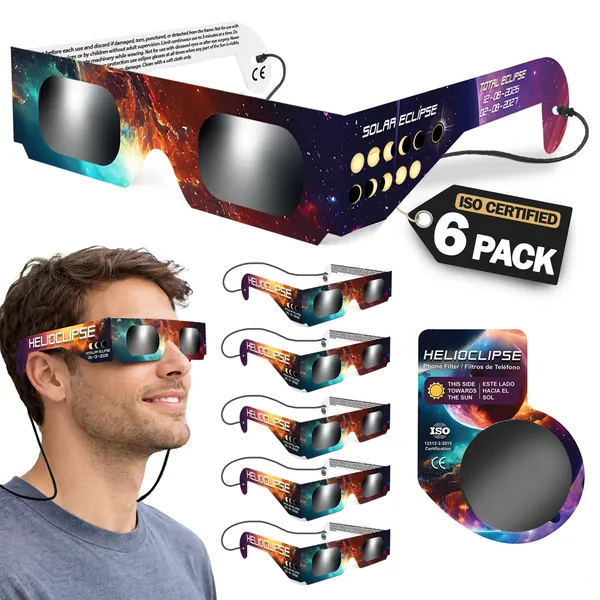 Certified to EN ISO 12312-2Helioclipse glasses · packs of 6-100from€24.95★ 4,8 (Amazon) · + phone filter · Free shipping · 5 countriesBuy
- TotalityEclipse T-shirtfrom€23.95Arrives in 3-4 working daysBuy
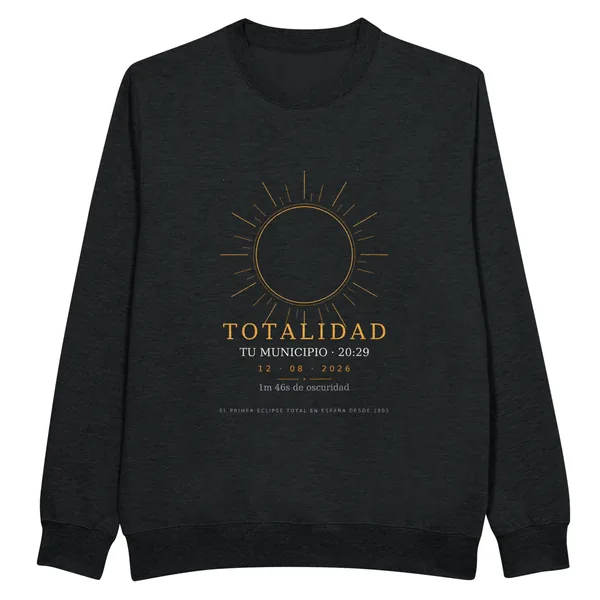 TotalityEclipse sweatshirtfrom€54.95Arrives in 3-4 working daysBuy
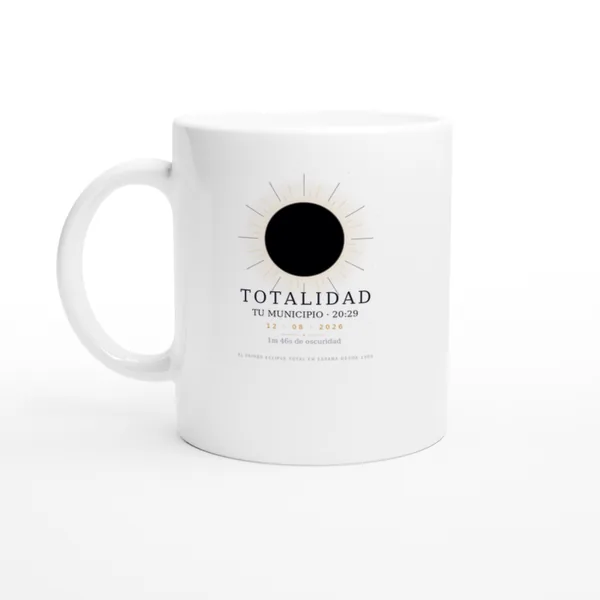 TotalityEclipse mug€26.95Arrives in 3-6 daysBuy
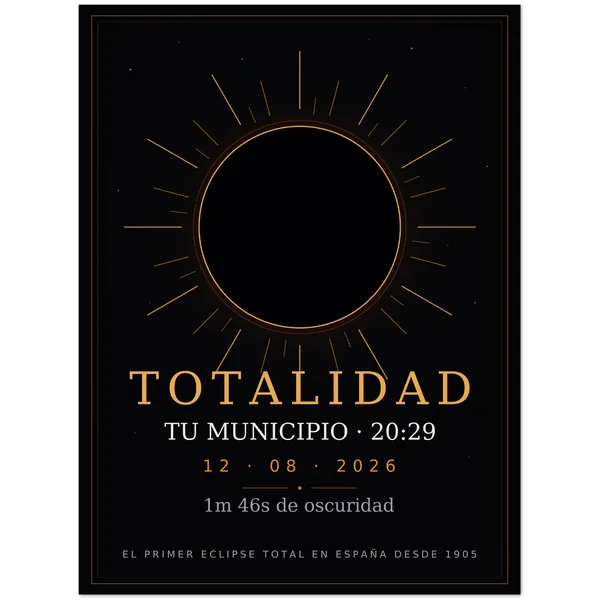 TotalityEclipse poster€32.95Arrives in 3-7 daysBuy
 TotalityEclipse tote bag€40.95Arrives in 3-4 working daysBuy
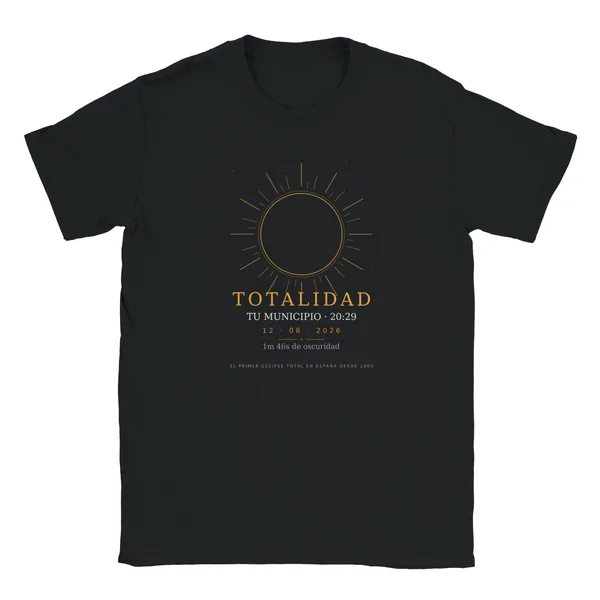 TotalityEclipse T-shirt · kids€27.95Arrives in 8-14 daysBuy
Our prices and delivery times come from the catalogue. Third-party gear is not made or shipped by us: the link goes to our own page, where the standard, the notified body and the date we checked them are written down, and from there to the shop with an affiliate link, at no extra cost to you. We do not publish Amazon prices because their affiliate agreement does not allow it; the Astroshop price is the one from the day it was checked.
Frequently asked questions about the eclipse in Pozo de Guadalajara
What time is the solar eclipse in Pozo de Guadalajara?
On Wednesday, 12 August 2026. In Pozo de Guadalajara, the partial phase begins at 19:36, maximum comes at 20:32 and the Sun will set still eclipsed around 21:14 (local time in mainland Spain and the Balearics (CEST, UTC+2)). Our own computation for the municipality's coordinates, cross-checked against the IGN (eclipses.ign.es).
Will the 12 August 2026 eclipse be total in Pozo de Guadalajara?
Yes. The Moon will cover the Sun completely for 0m 55s, with maximum at 20:32. It is the first total eclipse visible from mainland Spain since 1905 (source: IGN).
How long does the eclipse last in Pozo de Guadalajara?
Totality lasts 0m 55s; the whole event, from the moment the Moon starts covering the Sun, lasts about 1 h 38 min. The Sun will set before the partial phase fully ends.
Which glasses do I need to watch the eclipse?
Eclipse glasses with the EN ISO 12312-2:2015 standard printed on them and a CE mark issued by a notified body (4-digit code). Check that your model appears among the verified ones at eclipseseguro.es, and follow the IGN safe-observation guidance at eclipses.ign.es.
Where do I go if it is cloudy in Pozo de Guadalajara?
AEMET (the Spanish met office) will publish the specific eclipse-day forecast in the final days: check it before choosing your observing spot. Check AEMET's official forecast (aemet.es, © AEMET) in the final days and have a plan B ready: our guides cover the areas with the best clear-sky statistics.
What if I miss it? When is the next eclipse in Spain?
On 2 August 2027 there will be another total eclipse visible from Cádiz and Málaga, and on 26 January 2028 an annular eclipse visible from Spain. On top of that, the night of 12 August 2026 coincides with the peak of the Perseid meteor shower (source: IGN).
Space available
Do you run a business in Pozo de Guadalajara?
Whoever is reading this page has already picked Pozo de Guadalajara for 12 August. What they still need is somewhere to sleep, somewhere to eat and something to do that afternoon — and right now this page cannot tell them.
You can appear here with your name, one line you write yourself, your phone number and your link, from today until 13 August. 95 € + VAT, no lock-in and no commission on bookings.
See how it worksor call +34 616 809 504
The data above is never for sale: nobody pays for a better forecast or to be listed as a better viewing spot.
Keep planning
The eclipse in the neighbouring municipalities
The municipalities closest to Pozo de Guadalajara, each with its own timings page (straight-line distance, our own computation):
- Eclipse in Pioz — total, 0m 51s , about 4 km away
- Eclipse in Santorcaz — total, 0m 49s , about 5 km away
- Eclipse in Valdarachas — total, 1m 00s , about 5 km away
- Eclipse in Los Santos de la Humosa — total, 0m 52s , about 7 km away
- Eclipse in Loranca de Tajuña — total, 0m 52s , about 8 km away
- Eclipse in Yebes — total, 1m 02s , about 8 km away
- Eclipse in Chiloeches — total, 1m 04s , about 8 km away
- Eclipse in Aranzueque — total, 0m 59s , about 9 km away
Circumstances computed for the coordinates of each municipality with JPL DE440s ephemerides and cross-checked against the IGN (eclipses.ign.es). All times are local.